Tuesday, November 15, 2011

BOSNIA, ZAGREB & TRIESTE, ITALY

BOSNIA, ZAGREB AND TRIESTE ITALY


     Leaving the memorable town of Jajce behind, we enter into a deep gorge which has us sandwiched between soaring rock formations.     
    

Many of the peaks are partially claimed by low-lying clouds and fog, but the scene is, nonetheless, captivating.                  


John’s well-thought-out travel route
has us driving via the secondary roads on our way to Zagreb, Croatia’s capital.  As we travel deeper into rural Bosnia’s uninterrupted countryside, I feel as though I have stepped into a time warp and am witnessing a peasant-like lifestyle, existing in much the same way as it did a century ago.  Small hamlets of modest Alpine style houses with smoke streaming from their chimneys, and vast expanses of farmland capture the landscape in all directions.  At times, we must yield the road to an antiquated tractor occupied by mom and pop, plugging along as if there were no other vehicles to share the roadway with.        
     In contrast is the modern city of Banja Luka where John detours from the planned route for a quick drive through the downtown area.  I am pleasantly surprised by a beautiful and well-kept city showing off its wide, tree-lined avenue, grand old buildings and well-dressed residents. We are pressed for time so we do not stop, and I must be content to take my photographs from the window of the car.


OLD TOWN ZAGREB
      
     We reach our destination of Zagreb by early evening.  My weary driver is glad to step out from behind the wheel and stretch his legs. He has delivered us safely to our destination, and provided us with an experience in Bosnia we’ll never forget.  WHAT A GUY!

XXX
     
     The next 3 days are spent in the company of our friends, Iva and Velibor, who are never at a loss for words, great hosts, and most of all, wonderful friends. 

        Iva, is an English teacher at a language school in Zagreb, and owns the VILLA BOZO apartment house in Baska Voda.  Thanks to her, I am able to live in this wonderful little village. 
       Velibor, is an attorney who loves to debate on just about any subject. And debate we do, but always in the spirit of friendship. He keeps us amused with his stories set to animation, the mood upbeat with his glass-half-full attitude, and assures our contentment with his easy going manner and generosity.  I have to say that everyone, yes, everyone, likes Velibor.  Just ask him, he’ll tell you with no modesty, and a big grin, “Everybody likes, Velibor!”
       Iva is a pretty blond with sparkling green eyes who loves to poke fun at herself when she trips over a thought process, “Well, I’m a blond you know!” she adds with amusement.  She is a real care giver, always making sure that our needs are met and our bellies full with another of her wonderfully prepared, mouth-watering, Croatian specialties.  And she always asks when we’re finished, “Is everything okay?” And of course it is always okay because she makes sure of it.  For the recipe lover, you might try her roasted red pepper dish at the end of this blog. I asked her for the recipe for the benefit of those of you who want to prepare something Croatian. Her response to my request was: “Well, I cook from experience, not books, so your friends must add the ingredients to their own taste.” So please, take Iva's advice

XXX


Zagreb is a great city to pass away a few days, and its coffee bars, up- scale malls, interesting architecture and high end shops can’t be beat.


       Dashing across the busy downtown streets we take care not to trip over one of the many sets of tracks that carry the rumbling blue trams through the city.  A stroll down one of the many busy sidewalks finds us window shopping and drooling over the Italian leather shoes and purses (ouch, the prices!) on display. 
      Situated in the town center at the top of a long flight of stairs is the colorful, Bolac, open-air food market which is easily identified by its bright red umbrellas.  The market is referred to as
the "belly of Zagreb" owing to the wonderful selection of foods brought
from all over Croatia. 
     Just a short distance away is the indoor market with its mingling aromas, strings of sausage suspended from hooks and throngs of shoppers. Here, you can find everything for the diner’s table.  For the gourmet, there is a selection of delicacies--some of which I couldn't even begin to identity, and far too numerous to mention. If you’re lucky, one of the vendors will invite you to sample their specialty.  Today we’re lucky, tasting the Mediterranean style marinated olives that explode with flavor in our mouths!  
     With camera in hand I become a market spectator, completely absorbed in the experience of shoppers pushing their dual-wheeled, canvas carts from vendor to vendor.  Croatian women are very decisive about what they want, and above all, everything that goes on their table must be fresh. They carefully view the items on display, then having made their choice, instruct the person behind the counter to slice, weigh and package their selection…all of this in less time then it takes me to focus the camera and discretely take a shot.  I have to keep a watchful eye on Iva, and John,--who is manning her cart--because Iva is quite purposeful with what she will buy for the evening meal, and I can easily lose them around a corner, and to the maze of stalls that follow.
      “What’s this and what’s that?” I ask with a peaked curiosity; even in the midst of all the noise, my English carries and the preoccupied shoppers turn their attention to get a look at the foreigner in their midst (the spectator is now being viewed.) If the camera wasn’t already a dead give away to my foreign status, than certainly the language is.  Unlike me, however---who tends to physically blend in to most European cultures--- there’s no mistaking, John, who has “Product of America” stamped across his wide, Anglo forehead, getting him the stares without ever opening his mouth.  
      Finally, our shopping experience is over, Iva’s shopping cart stuffed to capacity with aged cheese, homemade prosciutto, bunches of fresh swiss chard, freshly ground meat for the Greek moussaka dish and a crusty loaf of freshly baked cornbread…which is nothing like our version in the U.S., either in taste or in texture.
     Needless to say, we are anxiously looking forward to tonight’s dining experience---the debates will have to wait until after dinner.  

XXX

This Sunday before our departure we take the funicular for the 66 meter ride (it only takes 55 seconds, and is the shortest passenger cable railway in the world) straight up the tracks to the charming, old historic district known as Gornij Grad (upper town.)
     In the center of St Mark’s square, there is a late Gothic style, 13th century church with a colorful tiled roof that forms two sets of coats of arms, the white castle on the red background representing Zagreb, and the other of the Triune Kingdom of Croatia, Slavonia and Dalmatia. 
     At noon every Saturday and Sunday, as a cannon is fired from a medieval tower neearby, you can simultaneously hear the clomping of a horse's hooves, and the sound of heavy boots hitting the cobblestoned street.  Closing my eyes for a few seconds I allow my imagination to take flight into another century, invisioning a city under attack and a command of marching soldiers converging on the town.  But when I open my eyes and wait a few more seconds, I see the high-stepping soldiers of the Honorary Cravat Regiment, rounding a corner into the square where they will perform the changing of the guard.


 Twelve soldiers, consisting of armourers, trumpeters, drummers, flag-bearers and their commander make up this impressive group.  It’s worthy to note that their uniforms are original 18th century, and that the cravat got its name from the distinctive scarf tied around the soldiers' necks.  
     I am easily swallowed up in the tightly packed crowd of tall, Croatian spectators, so I must nudge my way to the front and peek through an opening to capture some shots. Since the soldiers are constantly on the
move, I’m doing a lot of dodging and weaving through the crowd, and for the most part, witnessing the ceremony through the lens of my camera.  Persistence pays off, though, for I have my pictures.             
     From the square we head for the peace and solitude of the Strossmayer Promenade, and take a leisurely stroll beneath the shade of the tall chestnut trees that line either side.
TAKEN XMAS 2010
      Since this area affords some of the most beautiful views of the city below, I lag behind soaking in the scenery. Veli, Iva and John, move ahead. Judging from the way they are huddled together, they are probably engaged in another of their debates…which should last all the way to the car park! 


TAKEN XMAS 2010

       It has been four days well spent in a beautiful city with great friends, but it’s time to move on, Trieste, Italy, being our final destination.


XXX 

Beneath a pewter colored sky we begin our journey on a four lane highway that cuts and tunnels its way through the mountains that belong, in part, to the country of Slovenia. It’s raining, but if we’re lucky and the temperature does not plummet, we won’t get caught in a snowstorm at the summit of the pass like we did in 2009 on our way to Venice, Italy.
     To my relief, John conquers the pass without incident, and leaving this segment of mountains behind we will start our decline to the borders of two countries, Slovenia and Italy. 
     Once in Slovenia, the road narrows to a two lane that meanders its way through lovely, present day, Alpine hamlets and lush forests showing off their autumn gold colors.
     Trieste is situated at the north east edge of Italy on the Adriatic.  Much of the city’s houses occupy the steep hillsides that spill down to the sea, making an impressive sight from the roadway above.     
     John navigates another city’s streets with relative ease following the signs to the harbor and historic district. We really don’t know what to expect because Trieste is not one of those Italian cities on the tourist trail. Because of its close proximity to Croatia, however, I have come here to see if it would be a suitable place for me to live for the months of January, February and March, allowing me to have another cultural experience.  And, it is only an hour or so drive to Venice, leaving open the possibility to further explore my Italian roots.  So our first stop will be the tourist office.
     Driving along the harbor with the Adriatic to my right and a magnificent piazza to my left, I am finding, to my sheer delight, that Trieste is another beautiful Italian city.  Wherever I look, there are endless strings of old buildings with beautiful facades and elaborate adornments; even the columns of street lights that line the wide avenue are a work of art. Oh those Italians!
     While we wait for the other tourists I find, to my surprise, that I am understanding a lot of the Italian that is being spoken.  Is she there, whispering in my ear?  She was, once upon a time, only a short boat ride away--my grandmother, Giovanna.  I can feel the little hairs on the back of my neck stand up.
     A few minutes with the pleasant female agent from the tourist board confirms my suspicions that living in Italy is expensive, and renting an apartment is out of the question. I am open to her suggestion that renting a room in the historic district near the piazza might be an alternativE, so off we go to see what Trieste has to offer.
     Much to my surprise we find a beautiful, and very large room in one of the grand old restored buildings of the historic district.  Aside from the fact that it has ambience galore, it also has many of the necessary amenities, and is stunningly appointed.  I love the high ceilings and trio of tall, shuttered windows, each with its own balcony.  In short, it reeks of charm, as does the attractive landlady who is accommodating, negotiable and speaks English.       
     Trieste is definitely a place where I could live, and immerse myself in the culture.  With shopping, restaurants, cafes, the Adriatic,
plenty of historical sights within walking distance, and Venice only 101 miles to the
west, it is worthy of consideration.  


OH SOLE MIO
But for now, Baska Voda waits.  My driver has earned a rest, and some well-deserved pampering for all of his efforts! 
BRAVO!


FROM IVA'S KITCHEN


ROASTED RED PEPPERS WITH FETA CHEESE

6 to 8 elongated red peppers ( purchased at Harry's Market) these peppers have a unique flavor.  If you can't find the fresh, try the bottled ones from Costco....but don't tell Iva I told you this!
Fresh garlic chopped
Feta Cheese
Vegetta (A croatian vegetable seasoning similar to our Mrs. Dash) I understand it has been introduced to the U.S., if so, try it!)
Plain Bread Crumbs
Fresh Cream
Oil


Roast peppers in 350 degree oven until tender.  Set aside in a covered dish to cool.  There will be a lot of liquid.
Peel skins from peppers (tricky--peppers may break a little but that's okay since you're not stuffing them with the feta.)
Oil the bottom of the roasting dish and dust with a thin layer of breadcrumbs (Iva says this helps to absorb some of the juice from the peppers.)
Layer the dish with the drained roasted peppers.  Sprinkle them with the vegetta, garlic, a few tablespoons of cream, and top with the feta cheese.
Bake 350 degrees until the cheese is slightly brown (approximately 20 minutes)

ENJOY!

REMEMBER, ADJUST TO YOUR OWN TASTE

THERE'S MORE IF YOU WANT...JUST COMMENT!

Thursday, November 10, 2011

BOSNIA'S SURPRISE

     We have decided to venture into another country and do some exploring.  Our destination is Zagreb, Croatia's capital, but in route we will make a two day detour through the countryside and mountains of Bosnia, Croatia's neighbor.                        
     Whenever one mentions Bosnia, it usually evokes a memory of war.  Many of us can remember America's intervention during the Clinton administration which helped put an end to the ethnic cleansing and a bloody war that claimed so many lives. 
     When we have mentioned our visits to Bosnia in the past, eyebrows have gone up. Visions of us becoming victims of some terror group, or being blown up by a leftover land mine have caused our friends to issue warnings of caution.   But I am sitting at this keyboard of my own free will,  and what I have seen and experienced so far should put many minds at ease after this writing.
XXX
     After a forty-five minute drive through Croatia’s interior we reach the Croatia/Bosnia border.  We approach the dingy and weathered border patrol buildings, but they appear to be closed, and we begin to wonder if anyone is guarding the border.  Finally, a uniformed officer with a gruff voice and a practiced manner approaches the car and asks for our passports and rental car information. We have no choice but to surrender our passports to him and wait while he disappears into the metal building.  He’s gone for an inordinate amount of time and I begin to feel a little tense.  Finally he returns, his manner softened and the hint of a smile on his face as he gives John directions and sends us on our way.
     Now we begin our climb into the mountains, leaving the coast of Baska Voda far behind.  It is an interesting drive through the countryside with its small hamlets, roadside tables displaying the homemade cheeses for sale and Turkish hand made pots and ironware.
We take a side road into one of the towns to get some Bosnian money from the bank’s ATM, after which we stop at a grocery store to buy food for our lunch.  A picnic is always part of our experience, even if it is eaten while seated in our car.  I promptly open the bag of lunch items and commence to stuff a ten inch, freshly baked crusty bread with a half pound each of sliced ham and Gouda cheese, wrapping it in paper, Taco Bell style, so that my “driver” can take it in hand and move on.  My lap is showered with large bread flakes and John is manning the wheel with one hand. There’s a bag of paprika-flavored potato chips on the console, and I’m holding a bottle of sparking water, alternating between that and the sandwich, so that John can water down the large gulps.  If not this exercise, he’s prone to double handle the food and use his knee to steer the car! Not a good idea on these roads.      
     A large town comes into view and John makes another detour to check it out.  The tall, needle shaped tower of a mosque soars skyward, and the surrounding architecture is Alpine.  

By request, John makes a quick stop--I can not resist snapping a few pictures.  There are odd, if not curious stares from passersby, but I just smile and meander down the road like I belong there, while my patient driver waits in the parking lot farther up the road pushing buttons on our new cell phone. 
      Just outside this lovely village the road narrows to accommodate a large river on one side and the sloping hills on the other.  It is a quaint scene of lovely little houses
dotting the hillsides, gardens overflowing with cabbage patches, and tall, cone-shaped haystacks in the surrounding fields. 

Some of the people are dressed peasant style, the women in long skirts, their heads covered with colorful kerchiefs. 


A man in a blue uniform is carrying a tall pole and coaxes his lone cow through the pasture, while a shepherd rounds up the stray goats that have decided to graze on the grasses next to the road.  It begs for the lens of the camera, and I’m itching to stop and capture it, but the heavy traffic dictates otherwise. 
     We are only 25 kilometers from our destination and the scenery of steep hillsides giving way to mountains, and the once arid landscape now replaced with lush forests tinted in autumn colors is nothing shy of breathtaking.   


By mid-afternoon we reach the picture-perfect, medieval town of Jajce (sounds like Yaytsay.)


John begins to navigate the narrow streets like a pro and before long we are driving past a lovely mosque
and entering the old town through the arched stone gates belonging to the fortress perched high above.


We’re eager to explore, but first things first---accommodations; with only two hotels
in the village the decision is simple.
      There’s still plenty of daylight left and a sunlit sky, allowing us to shed our jackets and walk the streets of the village.  We look in the shop windows, amble along the side steets and look at the faces of the people that share the sidewalk with us.  From the mosque, a loud speaker sounds out a male voice chanting a prayer. In no time the streets empty, leaving us to wander and explore them on our own.
     When we come to a steep and narrow cobblestone street and ascend its incline, we are lured by a set of well-worn stone steps leading up to an arched stone gate, and are compelled to see what's on the other side.


We are alone here, climbing, our imaginations peaked, looking into the medieval ruins, peering through the windows of an ancient mosque, sharing the surrounding space with the ghosts of another time, still unaware of what waits at the very top.
    

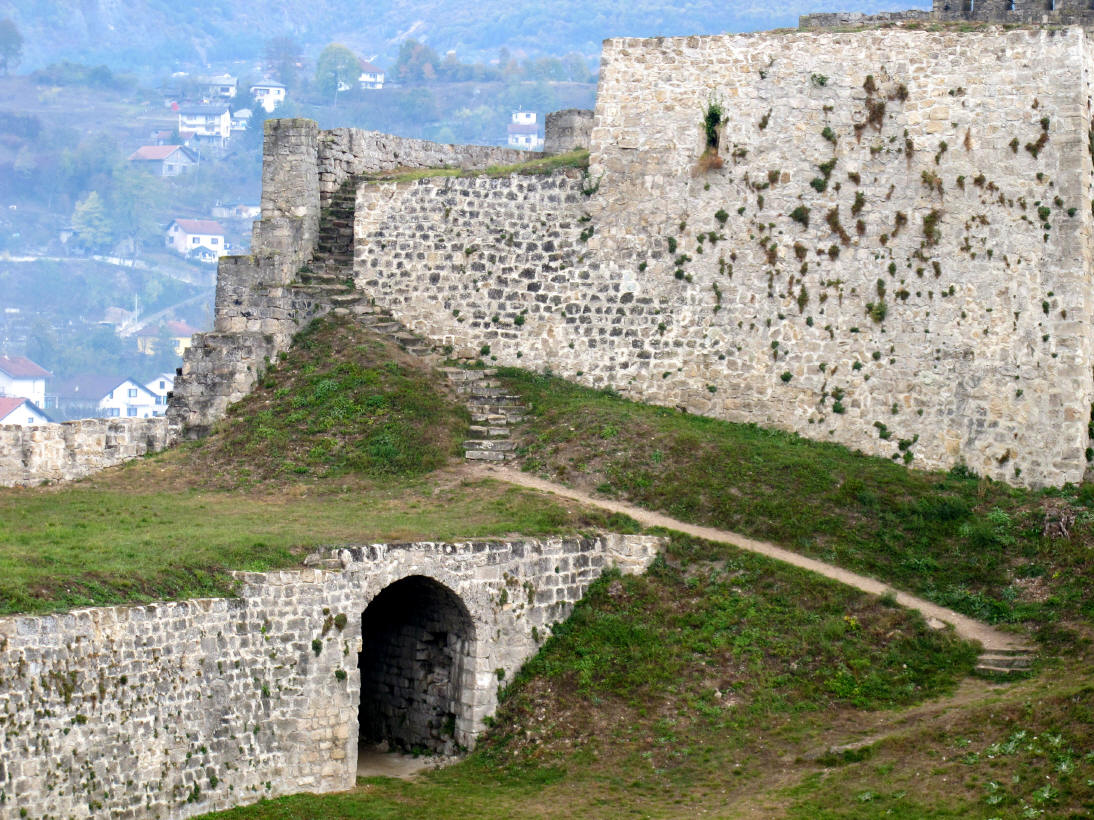
    We have reached a long stone wall that belongs to the fortress.  Everywhere is quiet, and still. A mist hovers above the hillls and houses beyond. 


There's a chill in the air and smoke coming from the chimneys in the town.  It's beautiful and serene and I want to plant myself here like the seed that found its way into the rock wall. 


We zip up our jackets and head down another path, back to the village that has once again come alive. 
     Thirsty from the walk we find an outdoor cafĂ© and sit beneath the umbrella to drink a glass of local beer.  The waiter is friendly and speaks good English, and he tells us, with a look of pride, that we are the first Americans he has ever seen in his village.   John orders another beer, offers to buy our new friend one, and in true, John, style, engages him in conversation. 
     When the subject of the war comes up, our young, soft-spoken waiter, Jasmn, a Muslim, is quite eager to share his experiences with us.  John asks him if he remembers the war. 
A REMNANT OF THE WAR
“I was ten years old and I remember it well.”  There is a trace of fear in his eyes as he speaks. “They came and shot at us in our homes.   It was very bad in the town.  Many of our people were killed.  I carried a rifle on my shoulder and was prepared to defend myself.   Even boys of eight years old had to do this.”
     I then ask, “Were did you escape to?” 
     He replies, “Up into the hills. We lived there for a long time.”
     The story is all too sad as Jasmn further describes the horror of the war that took a huge piece of his childhood.  In the end, all we can ask is, why?  What was gained?Even Jasmn has no explanation.
     Later, as we sit at the small restaurant behind Jasmn’s bar enjoying a meal of thinly sliced grilled veal, a hearty beef soup with homemade pasta and a wonderful Bosnian pancake, John once again engages a local in conversation.  This man, too, is eager to share more about this famous, medieval town’s turbulent history, namely it's long Austro-Hungarian rule, which explains the strong Austrian and Turkish influence evident even to this day.    
     “Which are you,” I ask, “Hungarian or Austrian?” 
     “I’m just me,” he tactfully replies with a grin.      
XXX
      We have to make the most out of what’s left of the sunny weather so we take the advice of the hotel clerk and take the “old” road that skirts the Pliva River. Three minutes out, we stop to view several man-made waterfalls spilling into the river. It’s a beautiful sight, but just a sample of what lies ahead. 


     Next, we come to a network of tiered waterfalls with their ribbons of white foam spilling over into glassy ponds, and reflections worthy of an artist's brush. It seems that all of nature has smiled upon this beautiful place, and today, we have it all to ourselves. 


A little farther up the road we come upon the Plava lakes with their blooming marsh grasses, mountain reflections and watermills resembling miniature houses nested in between. All of this is set against a backdrop of merging mountain ranges colored in Mother Nature’s Autumn palate. It is a visual overload to say the least!     


     A drizzling rain threatens to bring our sightseeing to a halt so we decide to wind up the afternoon with a visit to the fortress. 
     There’s a lock on the massive wooden door that leads inside and we are just about to leave when a man appears with a key and a booklet of tickets.  John hands him the equivalent of seventy-five cents each for our entrance fee and the man, seeming happy to have carried out his caretaker’s task, gives us a broad smile, exposing the empty spaces between his teeth.  


I’m not real keen on seeing another medieval fortress, but once inside the gutted walls, it affords us the opportunity to walk the top of the wall and  take in the breathtaking views.


Outside, our semi-toothless caretaker waits by his little stall of souvenirs.  I can not resist asking him to pose for the camera.  Much to my surprise he consents, but when he stares blankly into the camera I insist on a smile. He points to his teeth. I assure him that it’s okay. He capitulates and smiles proudly for the camera. 
     Does he not remind you of a "certain" medieval character from a French novel?


     The heavy rain has come bringing with it a raw cold, and definitely putting an end to the sightseeing.  But no matter, for we’ve been richly rewarded by this beautiful little town, which, in my opinion, has more than lived up to its reputation of being “among the oldest, most famous and, beyond any doubt, the most beautiful town in Bosnia Herzegovina.”